India's government is preparing to bring back merchant fees on UPI payments, a move that would hand its biggest financial benefit to PhonePe ahead of a widely expected IPO. The proposed amendment to the Payment and Settlement Systems Act would remove Section 10A, the clause that has kept UPI merchant discount rates at zero since January 2020.
MDR, or merchant discount rate, is the fee a merchant pays to a payments company every time a customer pays digitally. For most credit card transactions, MDR has always existed. For UPI and RuPay debit cards, it was zeroed out after a 2019 budget announcement, effectively making those payment rails free to use for merchants. The government now wants to reverse that, with the new MDR to be set by government notification rather than left to the market.
Who captures the most revenue
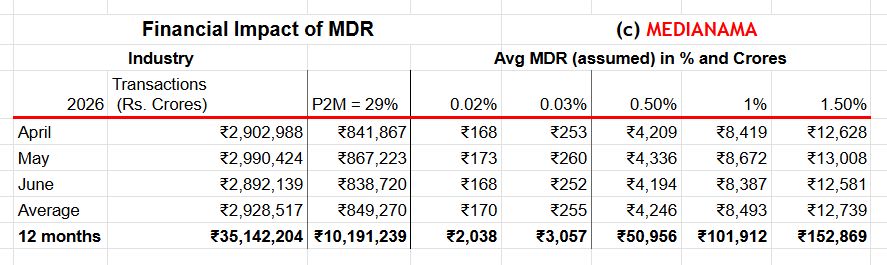
PhonePe commands 49% of UPI value transacted over the past three months, according to NPCI data. That position makes it the single largest beneficiary of any MDR revival. Estimates based on publicly available NPCI figures and a government press release with 2025 data suggest that PhonePe alone could collect anywhere from roughly Rs. 1,000 crore to Rs. 75,000 crore annually, depending on where the MDR rate lands. The wide range reflects an assumed average MDR of 0.02% at the low end and 1.5% at the high end, applied to merchant transactions estimated at 29% of total UPI value.
Google Pay, the second-largest player, stands to collect between roughly Rs. 683 crore and Rs. 51,000 crore on the same assumptions. Together, PhonePe and Google Pay handle around 83% of all UPI volume, which means the bulk of any new merchant fee income flows to just two companies. That concentration is not incidental: it is the direct result of how the market has developed, and MDR revenue would likely reinforce it further by giving both platforms more capital to spend on growth.
Walmart, which retains majority ownership of PhonePe after any IPO, stands to benefit as a foreign corporate from an Indian domestic payments rule change. PhonePe is actively preparing to list, and a credible MDR-based revenue line gives it a concrete monetisation story to present to institutional investors, something UPI apps have historically lacked.
What the government gains and loses
The practical value of zero-MDR UPI to the state was never primarily about convenience. Because UPI became treated as equivalent to cash by both merchants and customers, merchants were effectively pushed to accept it. Digital receipts create a verifiable money trail, landing in bank accounts rather than remaining off the books. That trail is useful for the GST department, which can use transaction data to issue tax notices to small merchants who might otherwise under-report income.
Reintroducing MDR gives small merchants a financial reason to nudge customers back toward cash. If merchants pass the fee to customers, customers have an incentive to reach for notes instead of phones. Both dynamics run counter to the government's own tax-surveillance interest in a cashless economy. The policy shift suggests the government now believes, or has been persuaded, that UPI usage habits are durable enough to survive some cost friction.
Analysts and observers also note sustained lobbying by the payments industry, and possibly pressure from the US government, as factors behind the change. PhonePe is backed by Walmart, and Google Pay is operated by Alphabet, giving two major American corporations a direct financial stake in how India sets its payments rules.
The rate itself will not be market-determined. The Reserve Bank of India is expected to set MDR levels, following a pattern typical of regulated fees: starting small enough that merchants barely notice it on a monthly statement, then rising gradually over time. A purely market-driven MDR would have created a different outcome: apps could compete on price, merchants could refuse payment from higher-cost apps, and smaller players like Paytm could offer zero MDR as a customer acquisition cost. That kind of price competition would be the first moment in UPI's history where one app is meaningfully differentiated from another on cost grounds.
The government's preference for a centrally notified rate forecloses that possibility, at least for now. It also means the duopoly of PhonePe and Google Pay is structurally protected from the one competitive lever that could have disrupted it most effectively.
What to watch: the actual MDR rate that the government notifies, whether the RBI is given formal authority to set and revise it, and whether PhonePe files IPO papers shortly after the amendment clears Parliament. Any rate above 0.1% on merchant transactions would represent material new revenue for the two dominant players and a meaningful new cost for the millions of small businesses that switched to UPI partly because it was free.