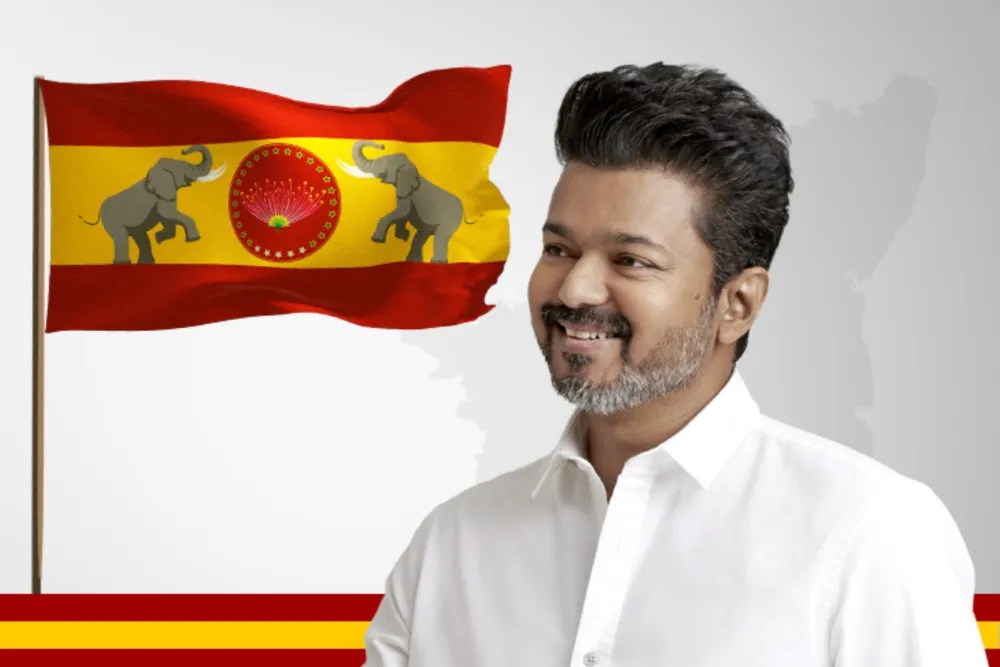
Actor-turned-politician Joseph Vijay Chandrasekhar was sworn in as Chief Minister of Tamil Nadu on Sunday morning at Chennai's Jawaharlal Nehru Indoor Stadium, ending a political era defined entirely by the two Dravidian parties that have held power without interruption since 1967.
Governor Rajendra Vishwanath Arlekar administered the oath of office. The ceremony marks the first time in nearly six decades that someone with no roots in either the DMK or the AIADMK, the two parties that have alternated power in the state, has taken the top job.
Who Is Vijay and How Did He Get Here?
Vijay, as he is widely known, is one of Tamil cinema's biggest stars. He founded his political party, Tamilaga Vettri Kazhagam (TVK), and contested the state assembly election on a platform that drew heavily on his mass fan base across Tamil Nadu. His victory breaks a mold that many analysts had considered near-unbreakable, the Dravidian political ecosystem, built over decades by leaders like M. G. Ramachandran, J. Jayalalithaa, and M. Karunanidhi, had successfully absorbed or sidelined every outside challenger since the late 1960s.
The win carries echoes of other South Indian film stars who converted screen popularity into electoral power, most notably M. G. Ramachandran himself, who founded the AIADMK after a career in cinema. But Vijay's rise is distinct: he has no legacy party infrastructure or dynastic backing, making his ascent faster and less expected.
What It Means for Tamil Nadu's Politics
For the DMK and AIADMK, this result is a structural blow. Both parties built their dominance on caste coalitions, welfare delivery, and strong organizational networks. A new entrant winning outright suggests those networks may be losing their grip, particularly among younger voters.
Tamil Nadu is one of India's most industrialized states, with a large manufacturing base, significant IT and auto sector presence, and deep trade ties. Political stability matters to investors and businesses operating there. A first-time chief minister with no prior governing experience will face immediate tests on industrial policy, fiscal management, and relations with the central government in New Delhi.
The BJP-led central government's relationship with Tamil Nadu has historically been tense. How Vijay navigates federal dynamics, including revenue sharing, infrastructure funding, and language policy, will be an early indicator of how his administration takes shape.
Watch for cabinet formation in the coming days, early policy signals on welfare and industry, and whether Vijay's government can consolidate a working majority through the assembly term.