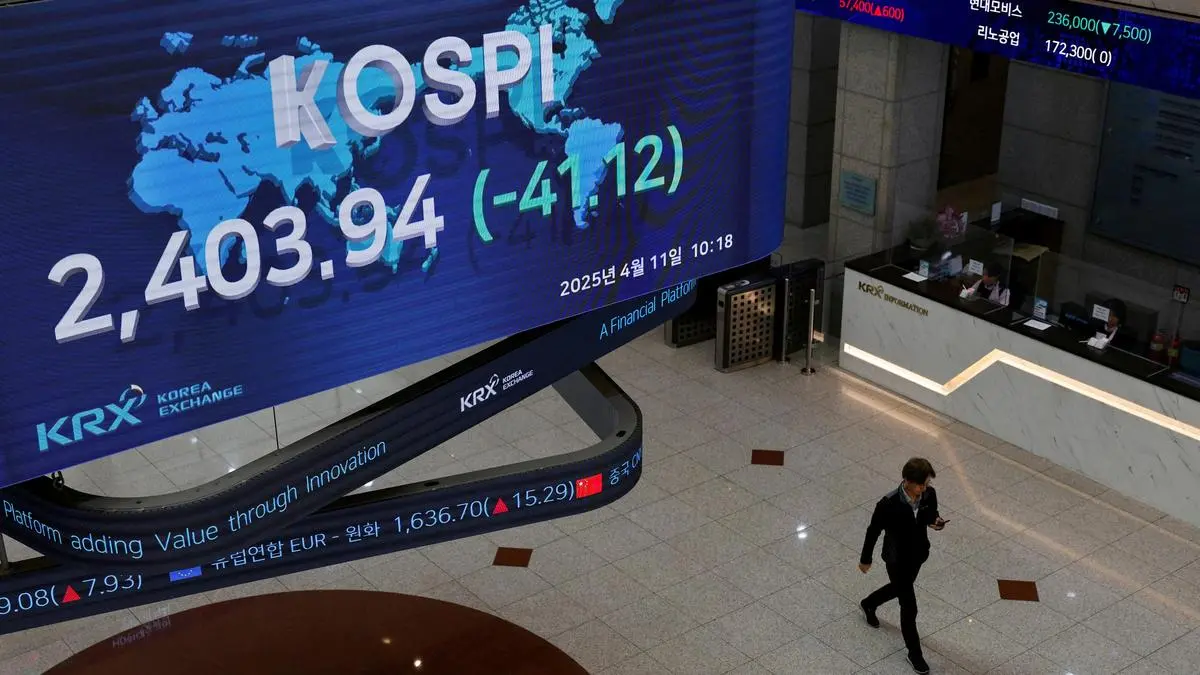
India has dropped to seventh place in global stock market rankings after South Korea overtook it, driven by a surge in AI-related chipmaker stocks that pushed South Korean listed companies to a combined market value of $5.01 trillion against India's $4.85 trillion on the National Stock Exchange.
The gap, while not enormous in percentage terms, marks a meaningful shift in how global capital is being allocated. South Korea's rally is largely concentrated in its semiconductor and AI hardware sector, where companies supplying chips and components to the global AI buildout have seen sharp valuation gains this year.
What drove South Korea ahead
AI chipmakers have been the engine of South Korea's market surge. As demand for AI infrastructure accelerates globally, companies in South Korea's technology supply chain have benefited directly. The rally lifted the total value of South Korean exchange-listed firms above the $5 trillion mark, a threshold India has not yet crossed.
India's NSE-listed companies, by contrast, sit at $4.85 trillion. That figure is not a decline in absolute terms from a recent peak, but the relative momentum has shifted. While Indian equities have had a strong multi-year run, the concentrated and fast-moving nature of the AI chip trade gave South Korean stocks an edge in the near term.
The ranking shift matters because global investors and index compilers watch these league tables closely. A country's position in global market cap rankings influences how much weight it receives in benchmark indices, which in turn affects how much passive capital flows toward its markets automatically.
Why this matters for India
India has been climbing these global rankings steadily over the past several years, at points overtaking markets like Hong Kong and France. Slipping back to seventh, even temporarily, is a reminder that the rankings are contested and that sector-driven rallies elsewhere can shift the order quickly without any deterioration in India's own economic fundamentals.
For Indian markets, the practical near-term consequence is limited. The NSE's aggregate valuation remains near historic highs, and the domestic economy continues to draw foreign institutional interest. But the comparison does spotlight a broader theme: AI and semiconductor exposure is now a significant driver of market cap rankings globally, and India's listed universe has relatively limited direct representation in that sector.
South Korea's chipmakers benefit from being embedded in global AI supply chains in a way that Indian listed companies are not, at least not yet. Indian technology companies tend to be weighted toward IT services and software rather than hardware manufacturing or chip design, which means they capture AI-related growth differently and, so far, more slowly in market cap terms.
The rankings can shift again quickly. If AI-driven momentum in South Korean stocks fades, or if Indian market sentiment improves on the back of domestic consumption, earnings growth, or policy tailwinds, the gap could close. Investors watching India's trajectory will want to track foreign institutional flows into the NSE, any structural changes in how Indian tech firms position themselves in the AI value chain, and whether the current South Korean rally has staying power beyond a narrow set of chipmaker names.