
Qatar Signals Progress in US-Iran War Talks
Qatar's foreign ministry said mediators including Qatar, Pakistan, and Oman have reached "very progressive stages" in efforts to end the US-Iran war, pushing Brent crude down more than four percent.
Key Takeaways
May 12, 2026 · 4 min read · By Rishabh Bhardwaj
·
AI-assisted, human-reviewed · Our editorial standards
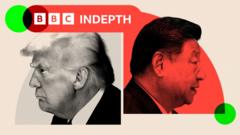
Donald Trump's visit to China stands as one of the most consequential meetings between American and Chinese leaders in recent memory. The two countries together account for roughly 40 percent of global economic output, and the direction they set in any summit shapes trade flows, technology investment, and geopolitical alignment for years afterward.
The meeting between Trump and Xi Jinping arrives at a moment of particular tension. Tariffs imposed during Trump's first term were never fully unwound, a tech cold war over semiconductors and artificial intelligence has hardened, and flashpoints from Taiwan to the South China Sea have kept military planners on edge. A summit at this level signals that both sides see enough shared interest to sit down, which is itself a shift from the colder posture of recent years.
Washington comes to the table with a crowded agenda. Trade deficits, fentanyl supply chains running through Chinese territory, and market access for American firms are perennial demands. The Trump administration has also pushed hard on technology transfer rules, seeking firmer Chinese commitments to stop the flow of advanced components to restricted parties. Any progress on these fronts would be framed as a win at home.
Beijing's priorities run in a different direction. China wants relief from export controls that restrict its access to advanced chips, recognition of its core interests around Taiwan, and a stable economic relationship that supports its own growth targets. Xi also benefits from being seen domestically as an equal partner to the United States rather than a supplicant. A meeting that produces visible respect and some tangible concessions serves that narrative well.
The gap between those two wish lists is wide. Historically, US-China summits produce joint statements full of constructive language and working groups that move slowly. Structural disagreements on industrial policy, state subsidies, and intellectual property rarely get resolved in a single meeting. The more realistic near-term outcome is a managed truce: a slowdown in escalation rather than a breakthrough on substance.
Several factors make this particular visit more significant than a routine diplomatic check-in. Trump's first term showed that his personal rapport with Xi produced unexpected moves, including the Phase One trade deal in early 2020, a partial agreement that paused a tariff spiral but left deeper structural issues unresolved. A second Trump administration with fresh leverage and fresh demands could follow a similar pattern: a headline deal that calms markets without fixing the underlying friction.
Markets are watching closely. Equity investors in both countries have priced in ongoing tension as a baseline, so any credible signal of de-escalation tends to produce a sharp rally, particularly in sectors exposed to cross-border supply chains: consumer electronics, electric vehicles, agricultural commodities, and semiconductor equipment. Conversely, a summit that ends without agreement or produces a public disagreement could accelerate the decoupling trend that has already pushed manufacturers to reroute supply chains through Vietnam, India, and Mexico.
The technology dimension is arguably the most durable. Controls on chip exports and restrictions on Chinese investment in American tech have bipartisan support in Washington, which means they will not disappear regardless of what Trump and Xi agree on trade. Companies on both sides have spent billions restructuring around that reality. A summit cannot easily undo those structural changes, but it can slow the pace of new restrictions and reduce the risk of an abrupt escalation.
Geopolitically, the meeting also sends a signal to third parties. Allies in Europe and Asia watch US-China relations as a barometer for how much they need to hedge their own positions. A visibly warm summit nudges some toward continued engagement with Beijing. A breakdown does the opposite, accelerating bloc formation. The ripple effects extend well beyond the bilateral relationship.
What to watch in the coming days: the specific language in any joint communique around Taiwan and technology, whether working groups are established with defined timelines, and how each side characterizes the meeting at home. Those details will tell more than the handshake photos about whether this summit produces durable change or just a pause.
Qatar's foreign ministry said mediators including Qatar, Pakistan, and Oman have reached "very progressive stages" in efforts to end the US-Iran war, pushing Brent crude down more than four percent.
Qatar confirmed it is mediating between the US and Iran but said no direct talks are currently planned. The clarification follows conflicting statements from President Trump, who claimed talks are under way, and Tehran, which denied any dialogue is happening.
Saudi Aramco reported sharply higher second-quarter 2026 profits as the Iran war restricts global oil supply and pushes crude prices up. Other oil supermajors also posted outsized earnings, raising concerns about sustained fuel cost pressure for importing economies.
President Trump called current Iran negotiations the "last chance" to end five months of conflict, pushing oil prices higher. Tehran denied formal talks are taking place, raising the risk of a diplomatic breakdown with direct consequences for global energy markets.