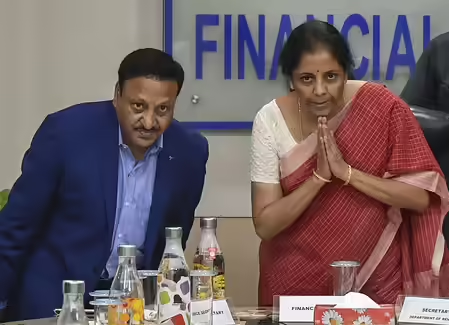
HDFC Bank has appointed Rajiv Kumar, a former IAS officer and ex-Chief Election Commissioner of India, as its Part-time Non-Executive Chairman. The bank's board approved his appointment as an Additional Independent Director for a four-year term starting June 30, 2026. His three-year term as Chairman is subject to approval from the Reserve Bank of India, and shareholders must separately consent to his directorship.
Kumar brings an unusually broad institutional background to the role. He served as Secretary of the Department of Financial Services under the Government of India, giving him direct experience regulating banks, insurance companies, and pension funds. He later served as Chief Election Commissioner, a constitutional post that requires handling large-scale institutional governance under public scrutiny. That combination of financial sector oversight and top-level public administration is what most non-executive chairman roles at large banks demand.
The appointment closes a search that the bank has been running for some time. HDFC Bank has been without a permanent non-executive chairman since Atanu Chakraborty's term ended, and the prolonged vacancy drew attention from investors and regulators alike. A non-executive chairman at a bank of this size is not a ceremonial post. The person chairs board meetings, provides independent oversight of management, and acts as the primary interface between the full board and the executive leadership team, currently led by MD and CEO Sashidhar Jagdishan.
Why the RBI's approval matters here
Under RBI guidelines, the appointment of a non-executive chairman at a private sector bank requires explicit regulatory sign-off. The central bank evaluates the candidate's fit and propriety before the role becomes effective. Until that clearance arrives, Kumar's chairmanship cannot formally begin even though his directorship is slated to start June 30, 2026. This two-track approval process, one for the board seat and another for the chairman designation, is standard for systemically important private banks and reflects how closely the RBI watches governance at institutions of HDFC Bank's scale.
HDFC Bank is India's largest private sector lender by assets and market capitalisation. Its board composition and governance quality are closely tracked by domestic and foreign institutional investors. A prolonged leadership gap at the chairman level can slow board-level decisions on strategy, capital allocation, and senior management succession planning, all areas where a functioning independent chair adds real value.
What changes next
The immediate next steps are regulatory and procedural. The RBI must grant approval for the chairman designation, and shareholders must pass a resolution approving Kumar's appointment as a director. Both processes typically run in parallel and are usually completed within a few months of the board's initial decision. Once cleared, Kumar will be expected to provide independent oversight at a bank navigating a competitive retail lending market, ongoing digital investment, and continued integration effects from its 2023 merger with HDFC Limited.
For investors, the headline consequence is straightforward: a governance gap that has persisted for over a year is close to being resolved. Stability at the chairman level reduces one source of institutional uncertainty. For the bank itself, having a chairman with direct experience in financial services regulation could prove useful as the RBI continues to tighten norms around credit growth, liquidity coverage, and executive compensation at large private banks.
Kumar's appointment does not change day-to-day operations, which remain Jagdishan's responsibility. But it restores the full two-tier governance structure that regulators and large institutional shareholders expect from a bank of this standing.