India has established the AI Governance and Economic Group (AIGEG), a cabinet-level body chaired by Electronics and IT Minister Ashwini Vaishnaw, with Minister of State Jitin Prasada as vice chairperson. The body consolidates AI policymaking across ministries that previously operated without a central coordinating authority, responding directly to calls in the government's AI governance guidelines and the Economic Survey. The AIGEG draws together the principal scientific advisor, chief economic advisor, CEO of NITI Aayog, secretaries from telecommunications, economic affairs, and science and technology, and a National Security Council Secretariat representative. A supporting expert committee will advise on global AI developments and regulatory priorities. The group is mandated to review existing frameworks, issue compliance guidelines, identify regulatory gaps, and assess whether new legislation is needed. On workforce, the AIGEG will map AI deployment readiness by use case, track automation trends, evaluate regional variation, and build transition strategies, an explicit acknowledgment that job displacement is a policy risk requiring active management. This sits within a broader regulatory push. Amended IT Intermediary Rules effective February 20, 2026, require platforms to label synthetically generated content. MeitY has also proposed mandatory three-hour content takedown windows and tighter compliance timelines for Google, Meta, and X. Stakeholder feedback on draft amendments is now open until April 29.
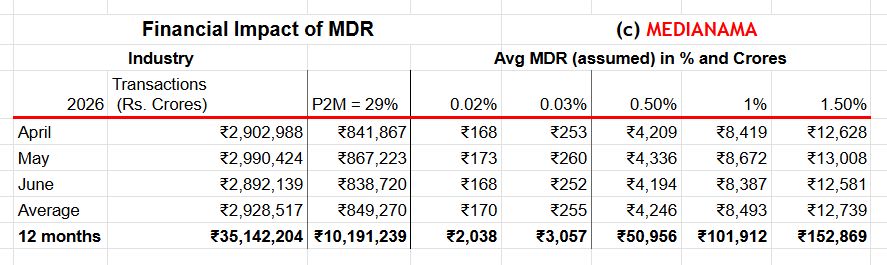
India's government plans to amend the Payment and Settlement Systems Act to restore UPI merchant discount rates, ending the zero-MDR regime in place since January 2020.
India's government has introduced the Taxation and Other Laws (Amendment) Bill, 2026, proposing changes to payments regulation, income tax, and the Finance Act to attract FDI and support Make in India. The Bill's final shape will depend on parliamentary debate and committee review.
The government's Taxation and Other Laws (Amendment) Bill, 2026, proposes to replace the blanket UPI MDR ban with a system allowing the Centre to notify which payment modes stay fee-free.
Prime Minister Narendra Modi inaugurated the Rs 5,000 crore Bhogapuram greenfield airport in Andhra Pradesh, built under a public-private partnership model. He also laid foundation stones for infrastructure projects worth nearly Rs 18,000 crore in the state, signalling a broad investment push for the region.