
Qatar Signals Progress in US-Iran War Talks
Qatar's foreign ministry said mediators including Qatar, Pakistan, and Oman have reached "very progressive stages" in efforts to end the US-Iran war, pushing Brent crude down more than four percent.
Key Takeaways
May 9, 2026 · 3 min read · By Rishabh Bhardwaj
·
AI-assisted, human-reviewed · Our editorial standards
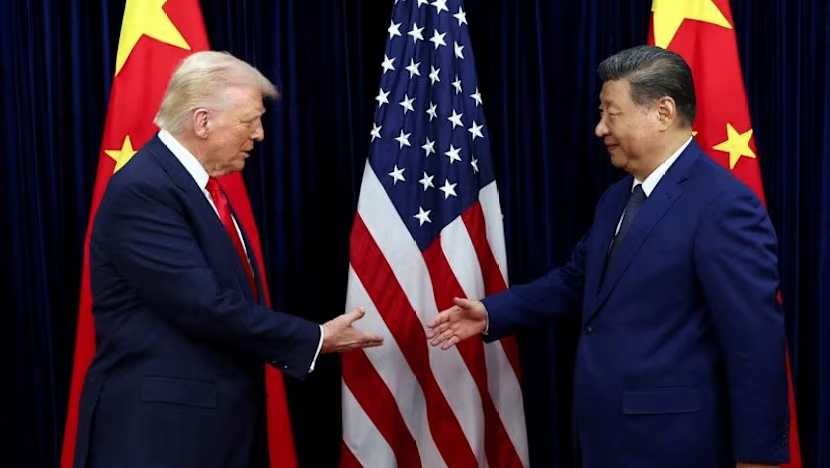
China has activated its so-called "Blocking Rules" against US sanctions for the first time, moving from a legal framework that existed largely on paper into active enforcement. The shift puts multinational companies operating in both countries in a genuinely difficult position: comply with one government's rules and you risk breaking the other's.
China's Blocking Rules, formally introduced in 2021, require Chinese entities, and foreign companies operating in China, to report and resist foreign laws that restrict normal trade and business activity. In practice, this means a company that follows US sanctions targeting a Chinese firm could face legal liability inside China for doing so. The rules were always designed as a countermeasure, but enforcement was rare. That has now changed.
The move mirrors tools that the European Union introduced decades ago, known as "blocking statutes," which were designed to shield EU companies from extraterritorial US sanctions. The concept is the same: a government creates domestic law that directly conflicts with a foreign sanction, forcing businesses to choose sides.
Global banks, logistics firms, technology suppliers, and manufacturers with significant exposure to both markets face the sharpest pressure. A company that cuts off a Chinese client to comply with a US sanctions list now risks being sued or penalised under Chinese law for that very act. Conversely, maintaining that relationship exposes the company to US enforcement, which can include fines, loss of dollar access, and exclusion from the US financial system.
This is not a theoretical risk. US secondary sanctions, penalties applied to non-American companies that do business with sanctioned entities, have already pushed many global firms to quietly reduce China exposure. China's enforcement of its own counter-rules adds a formal legal cost to that calculation on the other side.
The practical consequence is compliance paralysis for some firms. Legal teams now have to weigh penalties from two jurisdictions simultaneously, and the answer is rarely clean. Smaller companies with less legal firepower are especially exposed.
Watch for how major financial institutions and European multinationals respond in the near term. Their decisions, whether to quietly absorb the risk, restructure supply chains, or lobby their home governments for diplomatic cover, will signal how far this enforcement shift actually reaches. Any escalation in US-China trade tensions could accelerate China's use of this tool further, making it a permanent feature of doing business across both markets rather than an isolated case.
Qatar's foreign ministry said mediators including Qatar, Pakistan, and Oman have reached "very progressive stages" in efforts to end the US-Iran war, pushing Brent crude down more than four percent.
Qatar confirmed it is mediating between the US and Iran but said no direct talks are currently planned. The clarification follows conflicting statements from President Trump, who claimed talks are under way, and Tehran, which denied any dialogue is happening.
Saudi Aramco reported sharply higher second-quarter 2026 profits as the Iran war restricts global oil supply and pushes crude prices up. Other oil supermajors also posted outsized earnings, raising concerns about sustained fuel cost pressure for importing economies.
President Trump called current Iran negotiations the "last chance" to end five months of conflict, pushing oil prices higher. Tehran denied formal talks are taking place, raising the risk of a diplomatic breakdown with direct consequences for global energy markets.